
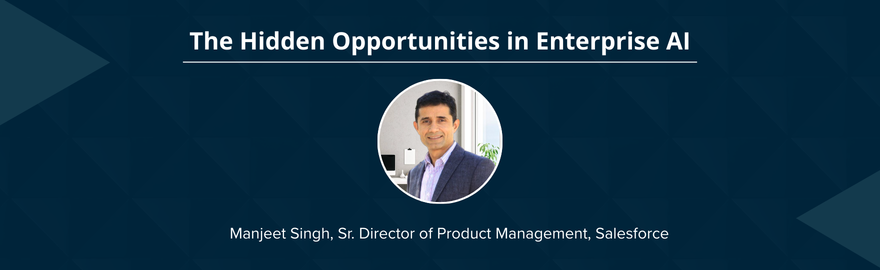
Salesforce AI leader Manjeet Singh breaks down where enterprise AI is delivering real ROI, where it fails, and how founders can build defensible AI startups.

The Influencer Series is an intimate, invite-only gathering of influential, good-energy leaders. The intent is to have fun, high-impact, “dinner table” conversations with people you don't know but should. The Influencer Series has connected over 4,000 participants and 15,000 influencers in our community over the last decade.
These roundtable conversations provide a space for prominent VC funds, corporate leaders, start-up founders, academics, and other influencers to explore new ideas through an authentic and connective experience.
Influencer Series: Where Enterprise AI Is Really Working and Why, with Salesforce AI Leader Manjeet Singh
Enterprise AI stands at a critical crossroads. Businesses investing heavily in AI implementations need frameworks to distinguish between projects with genuine ROI potential and those destined for failure.
In this episode of the Alchemist Influencer Series, Ravi and Manjeet Singh, Senior Director of Product Management, Salesforce AI Cloud (and Agentforce platform), explore the current enterprise AI landscape, examining successful implementation patterns across industries. Drawing on Manjeet Singh's unique experience scaling AI across startups and Fortune 500 companies, we'll identify opportunities for innovation and sustainable competitive advantage.
Key takeaways
-
Software development and customer service lead enterprise AI adoption because they involve well-defined, contained outcomes that today’s technology can reliably deliver.
-
The greatest startup opportunities exist in domain-specific vertical applications where deep expertise creates moats that generic AI frameworks can't easily replicate.
-
Enterprise AI toolchain infrastructure represents a significant gap, with testing, observability, and performance management systems desperately needed across all implementations.
-
Speed matters more than perfection in AI startups, as rapid iteration combined with domain expertise allows smaller players to outmaneuver platform companies.
-
Understanding current AI capabilities and limitations provides the essential foundation for successful implementations rather than chasing applications beyond technological readiness.
The Current Enterprise AI Landscape
Enterprise AI adoption currently manifests in two distinct forms. Conversational agents tackle specific role-based functions across sales, marketing, product management, and customer service. Meanwhile, background automation tools enhance workflows without requiring user interaction, quietly improving efficiency, and productivity metrics.
Most organizations find themselves in an uncomfortable middle ground. They've built impressive prototypes and conducted successful demonstrations, yet struggle to bridge the chasm between proof-of-concept and production deployment.
That MIT report claiming 95% of AI projects fail has generated considerable anxiety. But here's the thing: the truth sits somewhere between catastrophic failure and unbridled success. Many failures occur during the POC phase as organizations navigate a steep learning curve around proper AI implementation.
On the flip side, successful deployments are already moving business needles. These implementations deliver measurable improvements to productivity, revenue conversion, and customer experience metrics that justify continued investment.
What Determines AI Implementation Success
The most successful enterprise AI implementations share a common characteristic: well-defined, contained outcomes. When the range of possible results remains relatively deterministic and covers 80% of use cases, AI tends to perform reliably.
Organizations achieving real AI success approach implementation as an iterative journey. They don't expect their first version to meet every quality benchmark, handle every edge case perfectly, or solve every problem.
One lens that really clarifies where AI makes sense is the cost of being wrong. High-consequence domains in regulated industries—healthcare, banking, finance, and government—demand greater domain expertise and quality standards. These environments create opportunities for specialized solutions that justify premium pricing because generic approaches carry unacceptable risks.
Top-Performing Enterprise AI Applications
Software development has emerged as the clearest AI success story. Tools like Cursor demonstrate substantial productivity gains once developers understand what they want to create and provide appropriate context for the AI to work with.
Customer service represents the second major breakthrough area. AI agents operate around the clock without fatigue, handling inquiries that traditionally required human agents, costing $30 per interaction. When AI can deliver comparable service for $1 per interaction, the business case becomes compelling.
Voice-enabled customer agents show particular promise. Anyone who's spent 30 minutes on hold with their internet provider understands the appeal of instant, intelligent service available at any hour. These implementations improve consumer experiences while simultaneously reducing operational costs.
Exploring Opportunities in Vertical AI
The most defensible startup opportunities exist in industry-vertical, domain-specific applications. These aren't scenarios where someone can grab an open-source framework or OpenAI API and build something competitive without years of specialized knowledge.
Legal technology illustrates this principle well. Companies like Harvey have built paralegal-specific AI that works effectively out of the box rather than requiring extensive customization. They've combined AI capabilities with deep legal workflow expertise to create solutions that generic tools can't match.
Startups should target multi-step workflows that cut across departments and require understanding specific taxonomies and operational practices. This complexity creates substantial barriers that casual competitors can't easily overcome.
They'll face the same challenges: hiring domain experts, iterating through countless versions, and building customer relationships. Speed matters. Startups that rapidly onboard quality customers and build momentum create defensible positions even against well-resourced competitors.
Exploring Opportunities in AI and Building the Toolchain
AI development practices currently lack critical components and infrastructure. Over two decades, software development accumulated robust toolchains for testing, deployment, and monitoring. AI lacks equivalent infrastructure.
To advance AI implementation, testing capabilities require immediate attention. Evaluating AI agents demands extensive permutation testing before organizations feel confident deploying to production. "Evals is all you need" has become a common refrain, but executing comprehensive evaluations requires sophisticated tooling that doesn't yet exist in mature form.
Observability, tracing capabilities, and performance management address another critical barrier. When an AI agent produces unexpected output, teams need visibility into the reasoning layer to understand why specific inputs generated specific results. Without this transparency, organizations hesitate to move implementations into production environments.
Performance management for AI agents represents yet another horizontal opportunity. These systems need appropriate KPIs for evaluating agent performance across various enterprise contexts, much like human performance management, but adapted for AI capabilities, limitations, and performance metrics.
Creating Defensible AI Startups
Building competitive moats in the AI era requires combining technological capabilities with unique domain insights that larger companies can't easily replicate. The concern about being "just a wrapper" on someone else's model is legitimate but not insurmountable.
Here's something to consider: AI platform companies carefully monitor token usage patterns. When they observe significant usage in particular domains, they investigate what problems users are solving and consider building native solutions. This creates real competitive pressure.
Startups gain an advantage through speed, domain expertise, and customer proximity. Moving fast while staying deeply connected to customer feedback allows smaller teams to iterate more quickly than platform players building for broad audiences. Once you've secured 10 or 100 customers, you've established a meaningful position.
The intersection of AI with healthcare and fitness represents one particularly interesting frontier. Preventative health applications combining AI coaching with fitness tracker data could finally deliver on promises that devices like the Apple Watch made years ago but couldn't fulfill without sophisticated data analysis.
Browser-based AI interfaces show promise for enterprise applications. Tools like Claude.ai, Perplexity, and Arc browser integrate conversational capabilities directly into research and content workflows, eliminating the friction of switching between applications and maintaining context across tasks.
Getting Started with Enterprise AI
Organizations should begin with a clear-eyed assessment of current AI capabilities and limitations. Pursuing applications beyond what the technology can reliably deliver wastes resources and creates skepticism that undermines future initiatives.
Domain expertise and industry-specific insights provide the foundation for implementations that transcend basic model capabilities. This expertise informs how you configure context, prepare data, and structure workflows to get reliable output from AI systems.
The Alchemist connects founders with the resources, mentorship, and community needed to build successful enterprise AI companies. Visit alchemistaccelerator.com to learn more about accessing Silicon Valley's knowledge, customers, investors, and service providers.
Building Your Enterprise AI Strategy
The fundamental principles of competitive advantage haven't changed. Distribution power, switching costs, and customer attention still determine market success regardless of underlying technology shifts.
What's changed is the speed required to establish position before platform players or competitors enter your space. Organizations that combine rapid iteration with domain expertise, while maintaining tight customer feedback loops, will outperform competitors with superior resources but slower execution. Those fundamentals remain as true in the AI era as they were when written decades ago.
Follow the Alchemist Accelerator Influencer Series on:
Thank You to Our Notable Partners
BASF Venture Capital
Investing globally since 2001, BASF Venture Capital backs startups in Decarbonization, Circular Economy, AgTech, New Materials, Digitization, and more. Backed by BASF’s R&D and customer network, BVC plays an active role in scaling disruptive solutions.
WilmerHale
A premier international law firm with deep expertise in Corporate Venture Capital, WilmerHale operates at the nexus of government and business. Contact whlaunch@wilmerhale.com to explore how they can support your CVC strategy.
FinStrat Management is a premier outsourced financial operations firm specializing in accounting, finance, and reporting solutions for early-stage and investor-backed companies, family offices, high-net-worth individuals, and venture funds.
The firm’s core offerings include fractional CFO-led accounting + finance services, fund accounting and administration, and portfolio company monitoring + reporting. Through hands-on financial leadership, FinStrat helps clients with strategic forecasting, board reporting, investor communications, capital markets planning, and performance dashboards. The company's fund services provide end-to-end back-office support for venture capital firms, including accounting, investor reporting, and equity management.
In addition to financial operations, FinStrat deploys capital on behalf of investors through a model it calls venture assistance, targeting high-growth companies where FinStrat also serves as an end-to-end outsourced business process strategic partner. Clients benefit from improved financial insight, streamlined operations, and enhanced stakeholder confidence — all at a fraction of the cost of building an in-house team.
FinStrat also produces The Innovators & Investors Podcast, a platform that showcases conversations with leading founders, VCs, and ecosystem builders. The podcast is designed to surface real-world insights from early-stage operators and investors, with the goal of demystifying what drives successful startups and funds. By amplifying these voices, FSM supports the broader early-stage ecosystem, encouraging knowledge-sharing, connectivity, and more efficient founder-investor alignment.
Alchemist connects a global network of enterprise founders, investors, corporations, and mentors to the Silicon Valley community.
Alchemist Accelerator is a global venture-backed accelerator focused on accelerating seed-stage ventures that monetize from enterprises (not consumers). The accelerator invests in enterprise companies with distinctive technical founders and provides founders a structured path to traction, fundraising, mentorship, and community during the 6-month program.
AlchemistX partners with forward-thinking corporations and governments to deliver innovation programs worldwide. These specialized programs leverage the expertise and tools that have fueled Alchemist startups’ success since 2012. Our mission is to transform innovation challenges into opportunities.
Join our community of founders, mentors, and investors.
.png?width=352&name=Influencer%20Series%20Website%20Thumbnail%20Final%20Draft%20(1).png)